Stop Trying to Hack Your Morning — Build a Breakfast Habit That Actually Lasts
Every January, millions of Americans make the same quiet promise to themselves: This year, I'm going to eat breakfast. Not just grab a granola bar over the sink. Actually sit down, actually eat something warm and real, and actually start the day feeling like a person. By February, most of those promises are collecting dust next to the unused blender.
So what gives? Why does something as simple as eating breakfast in the morning — arguably the most natural thing a human being can do — feel like such a monumental commitment to keep?
The answer, it turns out, has a lot less to do with willpower and a lot more to do with how habits actually form in the first place.
Your Brain Doesn't Care About Your Goals
Here's the hard truth behavioral psychologists have been saying for years: your brain is not interested in your aspirations. It's interested in efficiency. Every habit — whether it's brushing your teeth or doomscrolling before bed — exists because your brain found a reliable loop it could run on autopilot. Cue, routine, reward. Repeat until automatic.
Breakfast routines fail, according to research in habit formation, because people try to install a new behavior without anchoring it to an existing cue. You decide you're going to wake up at 7 a.m. and make eggs. But 7 a.m. rolls around and there's no trigger pulling you toward the stove. There's just a vague intention floating in a tired brain, competing with your phone, your inbox, and the very real possibility of five more minutes of sleep.
Dr. Wendy Wood, a habit researcher at USC and author of Good Habits, Bad Habits, has argued that nearly half of our daily behaviors are habitual — meaning we're not consciously deciding to do them at all. The people who eat breakfast consistently aren't more disciplined. They've just built a system where breakfast happens almost automatically.
The Cue You're Probably Missing
Think about the morning rituals that never slip. You wake up and make coffee. You brush your teeth after the shower. You check your phone before your feet hit the floor. None of those things require a pep talk. They happen because they're chained to something else — a cue that fires reliably every single morning.
Breakfast needs the same treatment. Instead of treating it as a standalone event that requires its own motivation, attach it to something that already happens without thinking.
Maybe it's the moment the coffee finishes brewing. Maybe it's right after you put the dog out. Maybe it's when your kids sit down for their morning cartoon. The specific cue matters less than the consistency. When breakfast becomes the thing that follows something else, it stops being a decision and starts being just what happens next.
Readers who've written to us at YiHop about finally cracking their breakfast habits almost always describe this kind of anchoring — even if they don't call it that. "I started making oatmeal the second my coffee started dripping," one reader from Columbus, Ohio told us. "I wasn't even thinking about it as a habit thing. I just needed something to do while I waited."
The Problem with 'Healthy' Breakfast Goals
Here's another place routines go sideways: ambition. Not in a motivational-poster way — in a very practical, very human way. People who are trying to build a breakfast habit often simultaneously decide that breakfast should now be nutritious, Instagram-worthy, and prepared in under ten minutes. That's a lot of pressure on a Tuesday.
The moment your breakfast routine requires more effort than you're willing to give at 7 a.m. on a Wednesday after a bad night's sleep, the routine is dead. You'll skip it once, then twice, and then skipping becomes the new habit.
Behavioral scientists call this the "intention-action gap" — the space between what you want to do and what you actually do when friction shows up. The fix isn't more motivation. It's less friction.
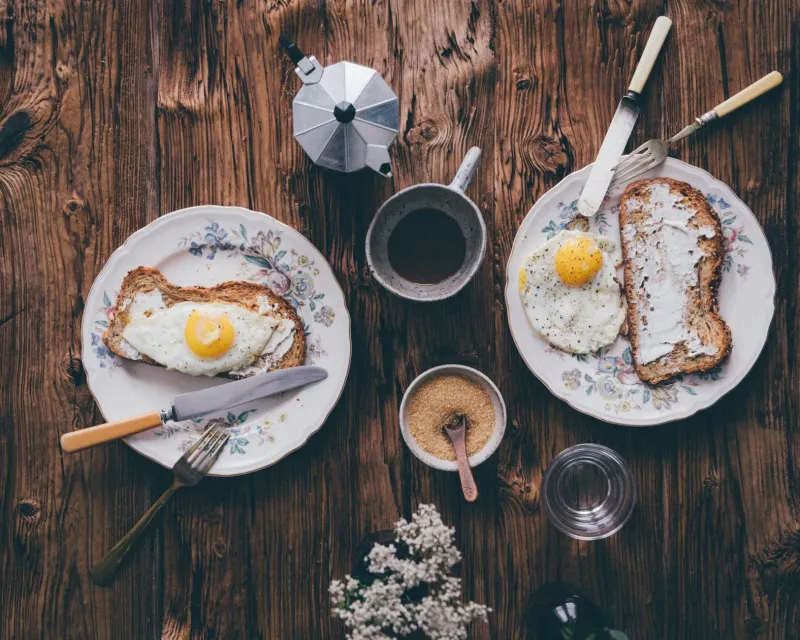
That means starting embarrassingly small. A piece of toast counts. A bowl of cereal counts. Two eggs scrambled in the same pan you use every morning, with no cleanup drama, absolutely counts. The goal at the start isn't nutrition optimization — it's repetition. You're teaching your brain that breakfast is just something that happens in the morning, full stop. The quality can improve once the behavior is locked in.
What 'Reward' Actually Means Here
The reward loop is where a lot of well-meaning breakfast plans quietly collapse. People expect to feel amazing after a week of eating breakfast — energized, focused, transformed. And sometimes that happens! But sometimes you eat oatmeal for five days straight and you just feel... fine. Normal. Like a person who ate oatmeal.
The trick is to build in a reward that's immediate and personal, not hypothetical. For some people, that's the breakfast itself — a meal they genuinely look forward to. A reader from Nashville told us she finally built a lasting breakfast habit when she started making the same French toast she remembered from her grandmother's kitchen. "It wasn't even about the nutrition. It just made me happy to make it."
For others, the reward is the ritual around the meal — the quiet before the house wakes up, the podcast playing in the background, the fifteen minutes that belong entirely to them before the day starts demanding things. At YiHop, we've always believed that breakfast is as much about the feeling as the food. That's not a soft take — that's actually the mechanism that makes habits stick.
When You Skip a Day (And You Will)
Here's the part nobody talks about enough: you're going to miss a morning. Life will happen. A kid will be sick, or you'll have an early flight, or you'll just completely forget because your brain was elsewhere. This is not failure. This is Tuesday.
Research from University College London found that missing a habit once has essentially no long-term impact on whether the habit forms — as long as you get back to it the next day. What derails routines isn't the missed day. It's the story you tell yourself about the missed day. "I already ruined it" is the most dangerous sentence in the English language when it comes to building any kind of consistent behavior.
Miss a morning. Shrug it off. Show up the next day with your eggs and your coffee and your slightly-too-loud morning playlist, and keep going.
The Morning That Feels Like Home
The breakfasts that last aren't the ones built on discipline. They're built on comfort, repetition, and just enough friction-reduction to make showing up easier than skipping. They're the meals that feel familiar — the ones that smell like something, that take up a few quiet minutes, that signal to your body and your brain that the day is starting on your terms.
You don't need a five-step morning routine or a meal-prep Sunday to make breakfast a real part of your life. You need a cue, a meal you don't hate, and a little grace for the mornings that go sideways.
That's it. That's the whole system. And it works a lot better than willpower ever did.